For global buyers, choosing a reliable Galvanized Pipe manufacturer requires more than comparing prices. Product quality, coating consistency, factory experience, and export reliability all matter. A pipe may look bright and smooth, yet its zinc layer can vary inside, around welds, or at threaded ends. Those small details often determine service life.
Tom Langill, Technical Director of the American Galvanizers Association, explains, “Galvanizing is a metallurgical reaction between the steel and molten zinc.” This principle helps buyers evaluate manufacturers more professionally. Strong suppliers control steel preparation, bath temperature, coating thickness, inspection records, and packaging. They also understand regional standards and project requirements.
This guide presents seven leading Galvanized Pipe manufacturers for international procurement. Each company is considered through practical factors, including production capacity, certifications, product range, delivery performance, and technical support. Samples, mill certificates, and independent inspections should still be requested before a major order. No ranking can replace careful verification.
Look beyond polished brochures.
A dependable manufacturer should answer clear questions. What steel grades are available? How is coating thickness measured? Can the factory protect threaded ends during ocean transport? Are replacement policies documented? These questions reveal operational maturity.
The selection process is not perfect. Public information may change, and supplier performance can differ by project. Buyers should treat this overview as a starting point, not a final decision. Direct factory communication, sample testing, and contract review remain essential for reducing avoidable risks in global Galvanized Pipe sourcing.
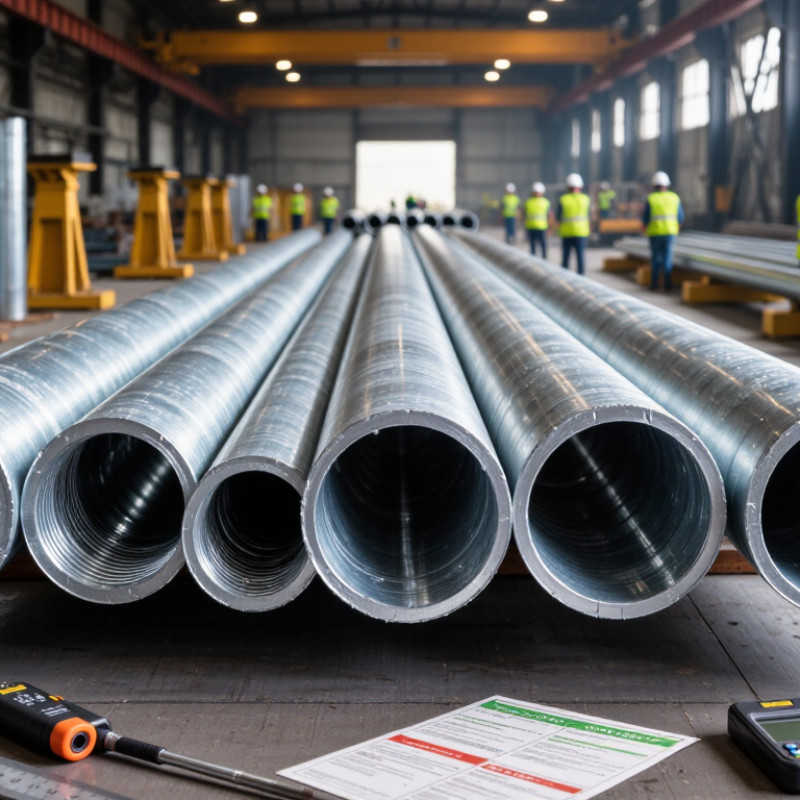
Galvanized pipes are steel tubes protected by a zinc coating. The zinc slows rust by forming a barrier around the steel. It also offers sacrificial protection when small scratches expose the surface. This makes galvanized pipe useful for water lines, fencing, agriculture, and structural applications. It is not paint. The coating becomes part of the pipe’s working surface.
Manufacturing usually starts with steel strip or a formed steel tube. The material is cleaned through degreasing, pickling, and fluxing. These steps remove oil, scale, and surface oxides. The prepared pipe then enters a bath of molten zinc, commonly near 450°C. Zinc bonds to the steel and builds several protective layers. Excess zinc is removed with air knives or controlled drainage. The pipe is cooled, inspected, and cut to the required length.
Details matter. Experienced inspectors check coating thickness, surface continuity, dimensions, and thread quality. A dull patch may indicate poor preparation, while heavy zinc buildup can affect fittings. The process is reliable, but it is not flawless. Rough handling can damage fresh coating before delivery. Storage also matters; trapped moisture between stacked pipes may cause wet storage stains. Buyers should verify test records, dimensions, coating requirements, and the intended service environment before ordering. A pipe suitable for outdoor fencing may not meet the needs of pressurized water service. That distinction is easy to miss.
A capable galvanized pipe manufacturer must prove more than production volume. World Steel Association data shows global crude steel production reached about 1.89 billion tonnes in 2023. This scale creates many suppliers, but quality can vary sharply. Buyers should request ISO 9001 certification, material certificates, coating-thickness records, and independent inspection reports. Test results should identify zinc adhesion, dimensional accuracy, tensile strength, and corrosion resistance.
Traceability matters.
Each bundle should carry heat numbers, batch codes, and production dates. These details help buyers investigate defects after delivery. ASTM A123 and ISO 1461 are useful references for hot-dip galvanized coatings, although the selected standard must match the project specification. A reliable factory should also explain its sampling plan instead of sending only attractive laboratory samples.
Logistics deserve equal attention. UNCTAD reports that maritime transport carries over 80% of global merchandise trade by volume. Therefore, export experience, seaworthy packaging, port options, and document accuracy can directly affect project costs. The World Bank’s 2023 Logistics Performance Index also shows meaningful differences in customs efficiency and shipment reliability between markets. Ask for recent delivery records, not broad promises.
Low price is tempting.
Still, comparing only the pipe quotation can mislead. Include coating life, rejection rates, inspection fees, inland transport, and replacement risks. I would also require a small trial order before committing to large volumes. It may slow purchasing, but skipping this step has caused avoidable problems in real sourcing work. No supplier is perfect, and buyers should examine weaknesses openly.
Seven Galvanized Pipe Manufacturers Worth Considering
Global buyers should compare capabilities, not attractive brochures. One integrated steel producer may offer stable chemistry and strong production control. A dedicated galvanized pipe mill can provide consistent zinc coverage across common sizes. A precision thin-wall manufacturer suits irrigation, fencing, and lightweight construction. Heavy-wall producers are better for demanding structural or industrial applications. Each option requires evidence.
A custom threading and grooving manufacturer helps when fittings must match project drawings. An export-oriented supplier may add value through seaworthy packing, container planning, and reliable documentation. A regional manufacturer with an in-house laboratory can support faster inspections and smaller orders. These seven profiles are worth considering for different purchasing conditions. Ask for coating thickness records, dimensional reports, batch traceability, and applicable ASTM, EN, or ISO compliance. Samples should be checked for bare spots, rough edges, damaged threads, and uneven zinc buildup.
I have learned that low price can hide costly rework. A polished certificate is not enough. Buyers should verify the issuing laboratory and production date. Some manufacturers communicate quickly but document slowly. That weakness matters during customs clearance and site inspection. Even experienced procurement teams can overlook pipe weight tolerances. A practical comparison should include factory audits, third-party testing, lead times, packaging photos, and after-sales response. Reserve judgment until the physical sample arrives.
Seven Galvanized Pipe Manufacturers Worth Considering
This neutral reference chart compares the outside diameters of seven commonly specified nominal pipe sizes. These dimensions are based on ASME B36.10M steel pipe size conventions and can help global buyers check dimensional compatibility when evaluating galvanized pipe suppliers.
When evaluating galvanized pipe manufacturers, quality begins with measurable standards, not attractive brochures. Reliable suppliers should state whether pipes meet ASTM A53, EN 10255, or another project-approved specification. Their zinc coating should be tested for thickness, adhesion, and surface coverage. A clear inspection report should show actual results, not only target values.
Certification also needs careful verification. ISO 9001 indicates controlled quality processes, while ISO 14001 reflects environmental management. These certificates should carry valid registration details and match the manufacturing site. Mill test certificates should include heat numbers, chemical composition, tensile strength, and dimensions. Traceability matters. A missing heat number can delay acceptance at the job site.
Export capability is equally practical. Experienced manufacturers provide seaworthy bundles, protective end caps, rust-resistant wrapping, and accurate packing lists. They should explain container loading, port arrangements, lead times, and applicable Incoterms. Pre-shipment inspection by an independent agency adds confidence, especially for large orders. Still, no certificate replaces physical checking. Coating can become uneven during handling, and small dimensional errors may escape routine sampling. That is an uncomfortable but useful reality. Ask for recent production records, sample photographs, and corrective-action reports before choosing a long-term supplier.
When comparing the seven best galvanized pipe manufacturers for global buyers, price should never stand alone. Request a line-by-line quotation. It should show pipe diameter, wall thickness, zinc coating, thread options, packing, and inland delivery. A low unit price can hide thinner coating or costly port handling. Ask whether prices are fixed or linked to steel costs. Record every assumption in the purchase file. This makes later negotiations less subjective.
Lead time deserves the same scrutiny. Ask for production days, inspection time, and booking windows separately. A supplier may promise 20 days, yet export documents can add another week. Request a realistic schedule with clear milestones. I prefer suppliers that share inspection photos, mill certificates, and packing lists before shipment. Check whether they have handled your destination port and required technical standards. One missed document can delay a container longer than expected. Keep a small schedule buffer. I once treated the quoted date as guaranteed, and that judgment was too optimistic.
Customer support becomes visible when specifications change. Test response quality before placing an order. Send three practical questions and measure clarity, technical accuracy, and response time. Strong teams confirm tolerances instead of simply saying yes. They also assign one accountable contact for production, quality, and shipping updates. Ask how complaints are logged and resolved, including replacement procedures for damaged bundles. Video inspections can help, but they do not replace independent checks for large orders. Keep written approvals. Spoken assurances are easy to misunderstand across time zones.
| Manufacturer Profile | Typical Product Range | Common Standards | Indicative Export Price (USD/metric ton) |
Typical Lead Time | Minimum Order Quantity | Zinc-Coating Range | Quality Documentation | Customer Support Capability | Best Fit for Buyers |
|---|---|---|---|---|---|---|---|---|---|
| Manufacturer Profile 1 | Hot-dip galvanized welded pipe; approximately DN15–DN300 | ASTM A53, ASME B36.10, EN 10255 | 650–950 | 20–35 days | 25–50 metric tons | 40–85 μm, depending on size and specification | Mill test certificate, coating report, dimensional inspection | English quotations, pre-shipment inspection coordination, standard export documents | General construction, water, and mechanical applications |
| Manufacturer Profile 2 | Threaded galvanized pipe and plain-end pipe; approximately DN15–DN200 | ASTM A53, BS 1387, ISO 65 | 680–1,020 | 25–40 days | 20–40 metric tons | 45–90 μm | Thread inspection, hydrostatic or air-test records, packing list | Thread and coupling confirmation, order drawings, container-loading photos | Plumbing distribution, scaffolding, and fire-protection projects |
| Manufacturer Profile 3 | Large-diameter galvanized welded pipe; approximately DN200–DN600 | ASTM A53, ASTM A500 where applicable, API 5L by agreement | 720–1,100 | 35–55 days | 50–100 metric tons | 50–100 μm | MTC, weld inspection, coating thickness records, third-party inspection option | Project scheduling, technical submittals, export packing consultation | Infrastructure, structural supports, and industrial utilities |
| Manufacturer Profile 4 | Precision galvanized carbon-steel tube; approximately 20–219 mm outside diameter | EN 10219, EN 10305, ASTM A513 by agreement | 800–1,250 | 30–50 days | 15–30 metric tons | 40–80 μm | Dimensional report, chemical analysis, tensile-test results, coating records | Custom tolerances, sample approval, engineering communication | Equipment frames, fabrication, and architectural metalwork |
| Manufacturer Profile 5 | Heavy-wall galvanized pipe for industrial service; approximately DN25–DN400 | ASTM A53, ASTM A106 for applicable uncoated steel pipe, ASME B36.10 | 850–1,350 | 40–60 days | 50–150 metric tons | 55–100 μm | MTC, pressure-test documentation, traceability records, inspection plan | Dedicated project contact, inspection-plan review, claims handling process | Industrial plants, utility networks, and demanding project orders |
| Manufacturer Profile 6 | Small-diameter galvanized pipe and cut-to-length products; approximately DN15–DN100 | EN 10255, ISO 65, ASTM A53 | 700–1,050 | 15–30 days for standard sizes | 10–25 metric tons | 40–75 μm | Basic MTC, length and quantity inspection, certificate of origin | Fast quotation response, mixed-size order coordination, low-volume support | Distributors, maintenance contractors, and small construction projects |
| Manufacturer Profile 7 | Galvanized structural hollow sections; square, rectangular, and round profiles | EN 10219, ASTM A500, JIS G3466 by agreement | 750–1,180 | 25–45 days | 25–75 metric tons | 45–85 μm | MTC, dimensional inspection, weld-quality report, coating inspection | Cutting and bundling options, drawing review, loading-plan support | Steel structures, fencing, solar mounting, and agricultural projects |
| Buyer note: Price ranges are indicative market benchmarks for standard export orders and can vary with steel prices, pipe size, wall thickness, zinc-coating requirements, Incoterms, destination, testing, packaging, and order volume. Confirm the latest commercial quotation, production schedule, applicable standard, and inspection requirements before placing an order. | |||||||||